April 20, 2026
The $100K Problem Hiding in Your Missed Calls
Most contractors lose more revenue to unanswered phones than to any competitor. Here's the math nobody runs — and what it actually costs you every year.

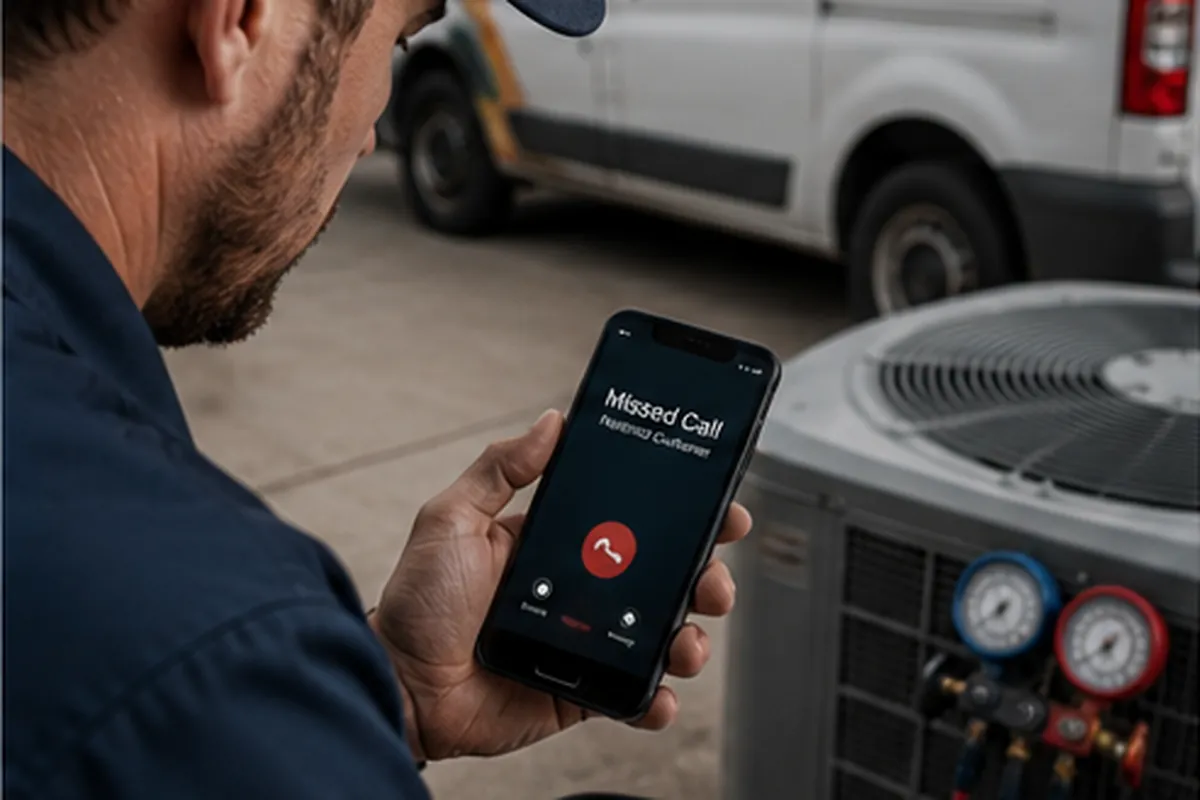
Here's a number worth sitting with: most calls to home service businesses never get answered during business hours. Not after midnight. Not on a holiday weekend. During the workday, while the lights are on and the trucks are out.
For every ten people who call your business today, a big share will hear the ring, then nothing, then voicemail. And the overwhelming majority of those people won't leave a message. They'll hang up, scroll to the next contractor on Google, and call them instead.
That's the part owners miss. You're not "losing leads" in some abstract funnel. You're handing warm, ready-to-buy homeowners directly to the competitor one listing down.
Why this happens to good businesses
It isn't a discipline problem. It's a physics problem. Your best techs are on roofs, under sinks, in attics — exactly where they can't pick up a phone. The office is one person juggling three things. A second call comes in while the first is still going. Lunch happens. The 7pm storm-damage call happens after everyone's gone home.
None of that means you run a sloppy shop. It means the phone is a single point of failure, and humans can't be in two places at once. The pattern is identical whether you run an HVAC shop, a roofing crew, or a plumbing operation — every trade where the work happens away from a desk runs into the same wall.
Run your own numbers
Before you take my word for any of this, plug in your real figures. Be honest about how many calls slip through on a busy day:
Interactive
What missed calls cost you
Drag the sliders to your numbers. This estimates the revenue walking out the door every time a call goes unanswered.
Missed calls / month
132
Lost jobs / month
33
Lost revenue / month
$264,000
Estimated annual revenue lost to missed calls
$3,168,000
Estimate only, based on ~22 business days/month. Your numbers will vary.
Most owners who do this exercise are quietly stunned by the annual figure. It's almost always larger than what they spend on advertising to generate those calls in the first place — which is the cruel irony: you pay to make the phone ring, then lose the call when it does.
The first contractor to answer usually wins
Speed isn't a tiebreaker in home services. It's frequently the whole game. When something's broken, homeowners don't comparison shop for three days — they call until someone picks up, and they tend to book the first competent person who does. Response speed routinely beats price and reviews as the deciding factor.
Which means the math cuts both ways. Every missed call you recover isn't just a saved lead — it's often a job your competitor didn't get. (The Harvard / MIT data on response windows makes this brutally explicit — respond within five minutes and you're 21× more likely to qualify the lead than at thirty. After that, the curve falls off a cliff.)
What actually fixes it
The honest options are limited. A bigger front office is expensive and still can't cover nights and weekends. A traditional answering service picks up, but it can't qualify the job, quote a range, or book the appointment — so you're still calling people back, by which point they've moved on.
The version that works is an AI voice agent that answers on the first ring, every time, around the clock — qualifies the job, captures the details your tech needs, books the appointment into your existing scheduler, and texts the homeowner a confirmation before they've finished their coffee. Twenty calls at once during the first cold snap, no new hires, no voicemail. What sounds like one receptionist on the call is actually several specialized agents working as a crew — a triage agent, a booking agent, a confirmation agent — handing the conversation back and forth in milliseconds. To the homeowner it's seamless; to your scheduler, it's just a new appointment showing up.
That's the entire reason we built what we built. Not because AI is interesting — because the alternative is watching six out of ten paid-for calls walk next door.
Curious what this looks like live? Get a free demo — our AI will actually call you and run the whole flow, so you can hear it before you decide anything.