June 8, 2026
How a Residential Roofing Company Actually Runs, From the Forecast to the Final Inspection
A phase-by-phase look at how a real Florida residential roofing shop runs, from pre-storm tile orders through mid-roof inspection, mediation, and final close.

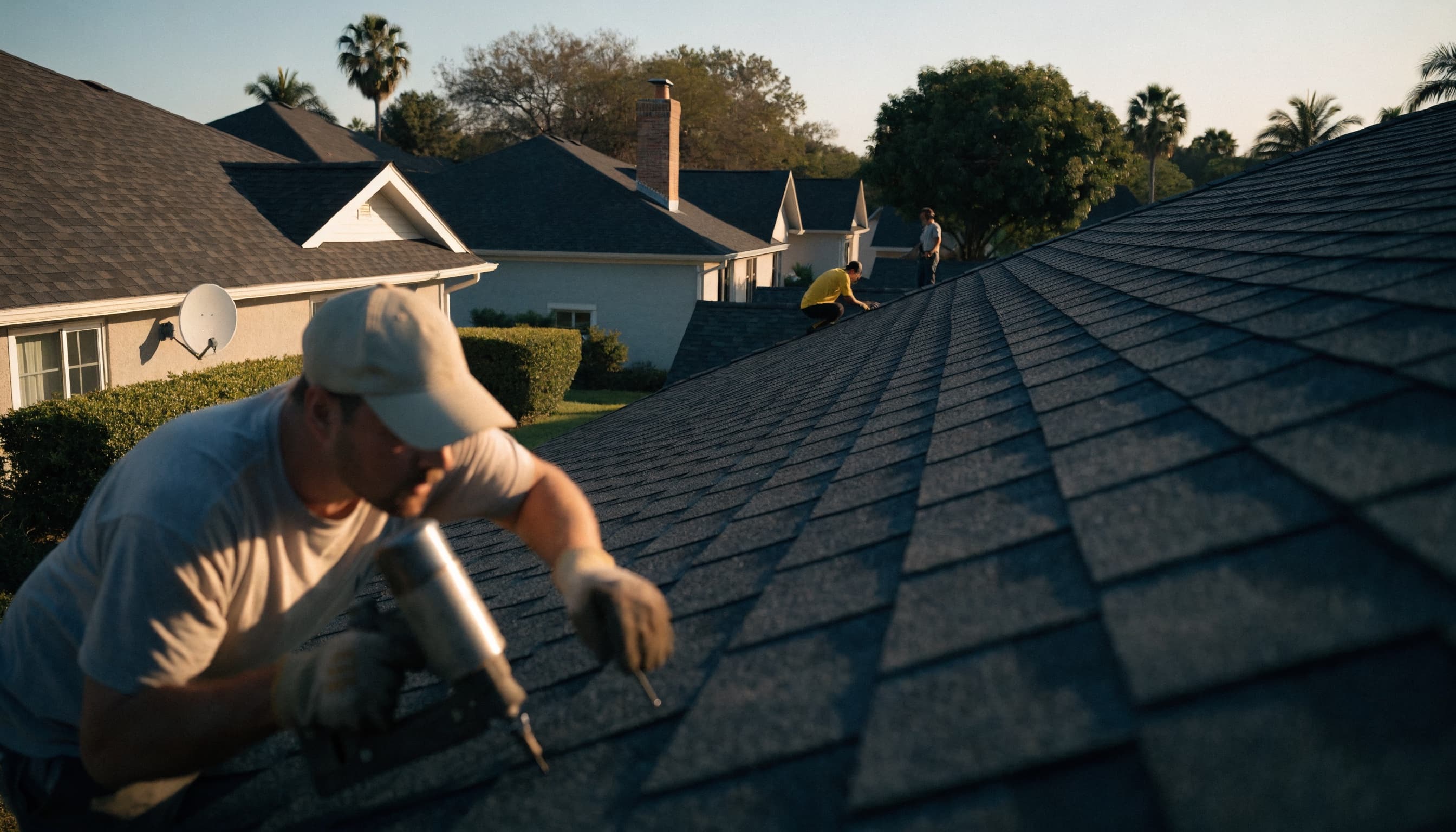
The Cone Hits 30%, and the Buyer Picks Up the Phone
Somebody in the shop is staring at the National Hurricane Center five-day cone on a second monitor. The named storm has crept past 30% probability and the line on the map is widening across the Gulf. The job board in AccuLynx is still quiet. The phones haven't started yet. That's the moment the buyer picks up the phone.
He calls Beacon. He calls ABC Supply. He calls the tile reps direct at Eagle Tile and Westlake Royal. He's not asking what's available next week. He's asking what he can put on a truck today and stage in the yard before every other roofer in Florida wakes up and does the same thing. Once landfall happens, tile dries up across the state inside 72 hours. The shops that pre-positioned start jobs in week one. The shops that didn't are still chasing freight in week six, watching their salesmen sign deals they can't actually build.
That phone call, three days before a storm even has a name, is the difference between a great year and a brutal one.
This post walks through what happens after that phone call. The whole lifecycle of a real Florida residential roofing shop, role by role, tool by tool, the way it actually runs. It's written for the 25-person Tennessee shop where the owner still rides on the truck Monday mornings, and for the 40-person Florida shop doing 70% insurance work where the owner sweats every regulatory bulletin out of Tallahassee. If you live in AccuLynx and EagleView every day, you'll recognize every phase. That's the point.
The Storm Hits, and Everything Routes Through the Traffic Manager
The morning after landfall, the phones don't ring. They explode. Homeowners calling about missing shingles, missing skylights, missing sections of roof. Carrier reps calling to confirm policy info. Walk-ins at the front desk with photos on their phones. Adjusters trying to schedule. Subs calling about availability. All of it lands on one human: the Traffic Manager.
In a smaller shop she's also the Office Manager. Same person, two hats. In a 40-person shop those are separate roles, and the Traffic Manager does nothing else but route during storm surge. Every inbound contact becomes a job jacket. In the old-school shops that's a literal manila folder with a sticker on the tab. In the modern shops it's an AccuLynx record. Either way, that jacket carries the job from this phone call all the way to the Certificate of Completion months later.
From the jacket, she puts the job on the board. Physical whiteboard in some shops, AccuLynx pipeline view in others, often both. Then she assigns. If the address sits inside a salesman's defined territory, it goes to him. If it's open territory, round robin. JobNimbus and Roofr work the same way for shops on those stacks, but in residential, AccuLynx is the system of record more often than not.
Here's the honest bottleneck: one person at the front of the funnel during a storm surge is where leads die on the floor. She's good. She's fast. She's still one person, and the phone is still ringing at 7:47 PM on a Tuesday.
The Salesman Books the Appointment and Builds the Packet
Appointment-making lives with the salesman, not a call center. He owns the relationship from the first call to the signature. He opens AccuLynx, opens the jacket the Traffic Manager created, books the appointment on his calendar, and the system spits out a job number. Every downstream record — the EagleView report, the Xactimate estimate, the photos, the contract, the carrier correspondence, the permit, the inspection passes, the checks — hangs off that job number for the life of the file.
Before he leaves the shop, he builds the door packet. Brochures. Manufacturer certifications: GAF Master Elite, Owens Corning Platinum Preferred, whatever the shop carries. Warranty literature. A copy of the state contractor license. A contract template. Tile samples from the bed of the truck. Modern shops carry the whole thing on an iPad. Old-school shops carry a binder. Most carry both because some homeowners still want paper.
Two things in that packet are non-negotiable. Current proof of company insurance, and current business title paperwork. Stale paperwork on either one is how you end up with a denied claim six months from now or a lawsuit two years from now. The shops that get this wrong don't get it wrong on purpose. They get it wrong because nobody owns making sure the packet is current on the morning of the appointment.
Worth noting: AccuLynx can now order an EagleView straight from Google Maps inside the job record. By the time the salesman pulls into the driveway, the roof dimensions, age estimate, and squares are already on the file. He's not climbing up there with a tape measure. He's walking up to the door with the numbers in his pocket.
At the Door, the Pitch Is the Easy Part. The Compliance Is Not.
The pitch is the part every salesman thinks is hard. It's not. Tile sample in hand, walk the homeowner around the property, point at the damage, talk through what the carrier is going to want, overcome the objections, ask for the signature. That part is a craft and a good salesman has it down inside his first year.
The hard part is the insurance work, which is where most Florida residential volume sits. The rules change every year. Every state is different. The salesman is the one standing in the homeowner's living room answering questions about what's covered and what isn't, and if he quotes last year's rule, it's the start of a claim denial six months later that the shop eats.
The way shops keep up is unglamorous. A regulatory-update meeting on a regular cadence, usually weekly, sometimes shutting the whole shop down for a full day when something material drops. Salesmen, specialists, office staff, superintendents, everyone in the room. Lost production for that day. They do it anyway because the alternative is worse.
At the door, the salesman captures the carrier (USAA, Citizens, State Farm, whoever), the policy info, the storm date, and the homeowner's signature. Florida has roughly a 60-day rescission window where the homeowner can back out. The rest of the shop knows that and paces accordingly. Once the contract is signed, the jacket gets an official job number on the board. It's no longer a lead. It's a job.
THE THREE PATHS FROM ONE PHONE CALL
Every storm call ends up on one of three tracks
Insurance, clean path. Carrier approves, 50% upfront, install, Certificate of Completion, back-half check, file closed. Most jobs in a normal year.
Insurance, rough path. Field adjuster, desk adjuster, denial or partial, mediation, re-inspection, lawyers on retainer, statutory clocks, eventual lump settlement. Months. Sometimes years.
Cash customer. No carrier, no statute, no legal exposure. 50% upfront, 50% on completion. Cash is king. Cash is easy.
The Handoff to the In-House Insurance Specialist
Once the signature is on the contract and the carrier is captured, the file routes out of the salesman's hands and into a dedicated In-House Insurance Specialist. This role exists because the work gets too complicated and too high-stakes for a salesman to carry alongside selling. He needs to be at another door tomorrow morning. He cannot also be on the phone with the carrier for ninety minutes about why the Xactimate line for drip edge was kicked back.
The specialist builds the claim file inside AccuLynx, builds the Xactimate estimate to match what the carrier is going to accept, talks to the field adjuster to coordinate the inspection, talks to the desk adjuster to push the file forward, and keeps the whole thing from going stale on somebody's desk in Jacksonville. On a clean claim that's a couple of weeks of low-key follow-up. On a contested claim it's the entire ball game.
Good specialists are the difference between an approved claim at full scope and a partial approval that costs the shop fifteen thousand dollars in scope the carrier refused to acknowledge. Shops that try to run insurance work without one usually figure out within a year that they need one.
The Carrier Approves, the First Check Lands, and the Office Manager Takes Over
Approval comes in. The carrier cuts the first check. The file moves from the specialist to the Office Manager, who handles money in and money out for the whole shop.
The standard structure on insurance work is 50/50. The first 50% is the ACV portion of the claim plus the homeowner's deductible. The second 50% comes on the back end. Three things have to be true before the back-half check moves: the roof is complete, permitting is done, and the Certificate of Completion has been issued by the city. All three. No shortcuts. The carrier is not going to release the back half because the roof looks done from the street.
The deductible rule is the one every owner needs to tattoo on the inside of his eyelids. The homeowner pays it. Period. Federal law, Florida state law, no exceptions, no creative arrangements where the shop quietly absorbs it to win the deal. Waiving the deductible, covering the deductible, discounting the job by the deductible amount and calling it something else — all of it is insurance fraud. License revocation. Carrier lawsuits. Possible criminal exposure. The carriers have data analytics looking for the pattern. They find it.
Matt's framing on this, talking to a roomful of owners: there's a lot you have to keep track of, or you can get in really big trouble. It's not a scare line. It's the operating reality.
Materials, Crew Assignment, and the Superintendent Takes the Job
The first check (or the percentage deposit on a cash job) is what triggers production. Materials get ordered against the job. The pre-storm tile that the buyer staged in the yard back in Phase 0 is now the reason this job can actually start instead of sitting in queue waiting on freight from Texas.
The job moves from the sales board to the production board. One of six or seven crews in rotation gets the assignment based on geography, current load, and the type of roof. From this point forward, ownership of the job belongs to the Superintendent. He runs it through install and the final walk.
The role progression on a clean job, in one line: the salesman closed it, the specialist worked the carrier, the office manager handled the money, the superintendent runs the build. Four different humans, four different skill sets, one job number tying them all together inside AccuLynx.
Permitting Is a Bottleneck With a Name on It
After payment and materials, before any tear-off, the permit has to be pulled. In Florida that means the county where the roof is. Not the county where the shop is. Not a state portal. The county.
Florida permitting is wildly inconsistent. Miami-Dade has its own building code that exists nowhere else in the country. A rural panhandle county might still take the application on paper. Some counties have decent online portals. Some require a human to show up at the counter with a folder. There is no statewide submission system that solves this.
So the shop has one Permit Coordinator whose entire job is this. She knows which clerk in which county takes which form. She physically drives to county offices when the portal is down or the application bounces. She's the reason a job that closed on a Tuesday actually has a permit posted on the house by the following Monday.
This is one of the places a job can sit dead for two weeks. Not because anyone is doing anything wrong, but because she's buried with thirty-five other jobs at the same time and there's only one of her.
Permit Posted, Tear-Off, Dry-In, and the Mid-Roof Gate You Cannot Skip
Permit goes up on the exterior of the house. Florida requires it to be visible from the street. Materials get delivered to the property the morning of, or the night before if the crew is starting at dawn.
Tear-off takes roughly a day on a typical residential roof. The crew strips the existing material, hauls the debris, exposes the deck. Then dry-in: synthetic underlayment goes down, seams sealed, the house is weathertight even if a pop-up storm rolls through that afternoon.
Then the gate. The mid-roof inspection has to pass before the new roof goes on. This is not a formality. This is the city inspector physically coming out to verify that the dry-in was done correctly before any tile or shingle goes down on top of it.
Skip the mid-roof inspection or fail it, and the whole new roof has to come back off later to expose the deck for inspection. Existential cost, both in dollars and in the carrier relationship. This is the single most common place where a shop without discipline loses serious money quietly. The job got built, the homeowner is happy, and six months later there's a problem because the gate was skipped.
CompanyCam photos at this stage are not optional. They're what gets sent to the inspector to schedule, what gets sent to the carrier later as proof of work, and what gets pulled up two years from now if someone disputes the install.
Install, the QA Walk, and the Sequence That Releases the Back-Half Check
Mid-roof passes. The crew puts the new roof on in one or two days. Cleanup starts before the last shingle is nailed: magnetic nail sweep across the driveway and the yard, debris hauled, tarps off the landscaping.
Then internal QA. The QA Inspector is a separate role from the Superintendent on purpose. The superintendent ran the build, so he's not the right person to grade his own work. The QA Inspector checks the install against the scope, the manufacturer specs, and the shop's own standards. Punch list goes back to the Superintendent.
The Superintendent does the final property walk with the homeowner. Walks the yard for missed nails, walks the gutters for debris, confirms the punch list is closed, gets the homeowner sign-off on a Certificate of Satisfaction inside AccuLynx.
Then the sequence that actually releases the back-half check, in order: request the city final inspection. City inspector comes out, passes the job. The city issues the Certificate of Completion. The CofC and the final photos go to the carrier. The carrier releases the back-half check. The file closes.
Payments cascade from there. Crew pay first. Salesman commission. Referral payouts. In that order, because the people who built the roof get paid before anyone else.
The Real Money Is the Referral Tree on That Block
The case study version of the math: a good job on one house turns into work on three more down the same street within a year.
The reason is structural, not magical. Storm-density neighborhoods are referral goldmines because every house on the block has a roof of roughly the same age, every roof took the same storm, and every neighbor saw the shop's truck parked in the driveway for three weeks. By the time the crew is rolling off the last job on the block, two more homeowners have already called.
Most shops run a formal referral bonus on top of the organic word of mouth. Cash to the referring homeowner, sometimes a tiered structure. The good shops have referral trees that go N levels deep — friend tells a friend tells a friend tells a friend. One genuinely happy customer can drive fifty-plus jobs over the years if the attribution is tracked.
Attribution disputes are real. Who actually sent the referral when the new homeowner mentions three different names? Shops settle that with data inside AccuLynx, not with memory and gut.
Reviews are a separate animal from referrals and matter for separate reasons. Local SEO rank for the shop's Google Business Profile. Trust signal for the next homeowner pricing three estimates. Early-warning system when a job goes sideways — the homeowner who's about to leave a one-star review usually emails first, and a shop that catches that email in time saves the review and saves the job.
Path B: When the Carrier Fights, the Specialist Calls the Lawyer
Not every claim runs clean. Sometimes the carrier tightens up, the file flips onto the rough path, and the timeline goes from weeks to months. Sometimes years.
The carrier process has three components, and outsiders confuse them constantly. The Field Adjuster is the first one. He comes to the property, gets on the roof, takes photos, writes up what he sees. Roughly 24 hours to inspect, roughly three days to file his analysis with the carrier. He's not making the decision. He's the eyes.
The Desk Adjuster is the second one, and he's a completely different person, usually in a completely different city. He receives the field report and makes the actual coverage decision. In Florida he has up to 90 days. He can approve, deny, partial-approve, or — most commonly on contested files — let it sit on his desk while he waits to see if the shop is going to keep pushing.
If the file comes back denied or partial, the third component kicks in. The shop's own E&O insurance and the lawyers it keeps on retainer get looped in by the Insurance Specialist. Florida has a formal mediation step administered by the Department of Financial Services, costs around three hundred dollars to file, and it's often the single move that unlocks a claim the carrier was trying to bury.
Re-inspection on the roof is a coordinated event. The shop's salesman, the shop's own inspector, and the carrier's adjuster all go up on the roof together. Photo evidence is required for everything — every damaged tile, every soft spot in the deck, every flashing detail. The carrier's adjuster often no-shows on purpose, because every delay is leverage. The shop documents the no-show in writing and the file keeps moving.
Mediation logistics matter. The owner of the shop usually attends mediation personally, because the decision to settle or fight has to be made in the room and the specialist doesn't have authority to commit the company. The mediator is selected from a pool of FL DFS-certified mediators. It's a whole separate process from the original claim work, with its own rhythm.
Florida statutory clocks frame everything. Three years to file the insurance claim from the date of the named storm. Five years for legal action. The Insurance Specialist keeps working the carrier even while the law firm is running the suit. Dual track on purpose. The file can age two or three years on this path and still close clean if it's worked correctly.
The legal endgame is the part most outsiders don't see. Most carriers fold when they see the shop has real will to litigate, because the math turns on them. Attorneys who work this space bundle similar cases against the same carrier — not a formal class action, but a coordinated set of suits that creates leverage in settlement. Process is roughly: file the suit, weeks of deliberation, settle on the courthouse steps.
The money flow on this path is entirely different from a clean insurance job. There's no 50/50 carrier checks. There's one lump settlement check at the end. Legal fees come out first. The lawyer takes his cut. The balance gets split between the homeowner and the contractor per the contract that was signed back in Phase 5, two years ago.
Cash customers are the contrast that puts all of this in relief. Same intake, same board, same install, same final walk. Skip the specialist entirely. Skip the carrier dance entirely. Skip the statutory clocks. 50% upfront, 50% on completion. Cash is king. Cash is easy.
WHAT STAYS HUMAN
The agents handle the clerical work. The roofers handle the roof.
The pitch at the door stays with the salesman. The homeowner wants a human walking her property, not an iPad reading from a script.
The mediation room stays with the owner. The decision to settle or fight the carrier is a judgment call that does not belong to software.
The mid-roof inspection, the QA walk, the final property walk — all human. Eyes on the deck, eyes on the gutters, hands on the work.
The agents handle the parts that drain the shop: triage during storm surge, EagleView orders, Xactimate line-item reconciliation, follow-ups with desk adjusters who are slow-walking the file, permit portal submissions, CompanyCam photo organization, review requests, referral attribution, regulatory-bulletin monitoring. The clerical mountain that buries a good shop on a busy week.
The Regulatory Layer That Can Sink the Whole Shop
Running over the top of every phase above is a continuous threat that doesn't show up on the production board: legislation. Somebody in the shop has to watch new state and federal regulation every week. When something material drops, the whole shop comes off the trucks for a day. That cost is real, and shops still do it because the alternative is a fine that ends the business.
Here's a concrete example that's not hypothetical. A roofing shop runs a routine 20% discount as a marketing promotion. Sounds fine. In a state with strict no-kickback rules on insurance work, a regulator or a carrier can interpret that discount as bribery, as inducement to file a claim, or as the contractor effectively covering the homeowner's deductible. None of those things were the intent. The statute does not care about intent. The shop is now defending itself against an insurance fraud allegation because of a marketing tactic that any other industry would run without a second thought.
The continuous oversight stack underneath the legislation is its own job. BBB standing has to stay clean. State contractor license has to be renewed on the right cadence, with the right CE credits documented. Permitting credentials for each county the shop works in. Surety bond, current. Workers comp insurance, current. Manufacturer certifications (GAF Master Elite, Owens Corning Platinum Preferred) renewed annually with field audits. All of it has to stay current all the time, because any one of them lapsing kills the shop's ability to take a check.
The operations backdrop nobody puts on the recruiting page: constant turnover in the trades. A roughly 60-day onboarding cycle per new hire just to get them to where they're not a liability on a roof. Recruiting that never stops, because the day it stops is the day the shop can't field a crew on a Monday morning.
This is the part that keeps the woman owner in Tampa awake at night more than the actual roofs do. The roofs she knows how to build. The regulatory layer is the one that can take everything down if she's wrong once.
If Your Shop Looks Like This, Here's the Door
This is what running a real shop actually looks like. Storm comes, jacket gets opened, salesman knocks on the door, specialist works the carrier, superintendent runs the build, permit coordinator drives to the county, QA inspector grades the work, owner sits in mediation when it goes sideways. AccuLynx in the middle, EagleView feeding it, Xactimate translating it for the carrier, CompanyCam holding the photo evidence, the county permit portal running on its own schedule, the regulator watching everything.
Any tool worth a damn has to plug into that universe without breaking it. If a vendor shows up with a demo that doesn't touch AccuLynx, doesn't pull EagleView, doesn't write back to Xactimate, doesn't reconcile CompanyCam, and doesn't know what a Certificate of Completion is — that vendor doesn't understand the business.
If you read this and recognized your own week, that's the whole point. The agents we build slot into the universe above. They don't replace the salesman at the door, the specialist on the phone with USAA, or the superintendent on the roof. They handle the clerical mountain that buries everyone else.
If you're running a shop that looks like this and you want to talk about where the pinch points actually are, book a demo. We'll wire it to your stack. No buzzword pitch, no demo theater — a working conversation about your AccuLynx, your carriers, your counties, your crews.
Internally we name our agents after sitcom characters. Keeps the engineers entertained. You'll never see them.
See it for your industry: HVAC · Roofing · Plumbing · Electrical.